
The Other Path · Education & stories
Why Our Shelves Changed: California Hemp Rules, CBD Smokables & Kratom
Field Notes from The Other Path · Updated October 31, 2026
If a familiar product has disappeared from a Los Angeles shop, changed its formula, or arrived with a different label, you have probably wondered: what happened?
The past year has brought a tangle of California hemp restrictions, local kratom enforcement, and a federal change often called the “hemp ban.” For a neighborhood apothecary—and for the people who depend on a familiar routine—those changes can feel personal.
Here is a guide to the changes most relevant to our Sherman Oaks community. Some were new laws; others were stronger enforcement of existing rules. We are focusing on retail access in Los Angeles and California, rather than trying to catalog every ordinance in every California city.
Why the shelves changed
Three different stories have often been rolled into one headline:
- THC in hemp products: California tightened the rules for products sold through the hemp market. This is different from banning all THC or closing the state’s licensed cannabis market.
- CBD smokables: California’s inhalable-hemp restrictions reach beyond products that get people high. A CBD flower product can still fall within the restrictions.
- Kratom: state and county public-health agencies have directed retailers to remove kratom and 7-OH products sold for consumption, using food-and-drug enforcement authority.
THC: “under 0.3%” stopped being the whole answer
The rules that set this transition in motion predate the last year. California’s September 23, 2024 emergency regulations required covered hemp foods, beverages, food additives, and dietary supplements intended for people to have no detectable THC per serving. They also established a 21+ purchase requirement and a five-serving package limit. Those were hemp-market restrictions, not a statewide prohibition on licensed cannabis. Read CDPH’s rulemaking explanation.
AB 8 was signed on October 2, 2025, just before the period covered by this update. Most provisions took effect on January 1, 2026, with additional changes scheduled for 2028. The law strengthened the state’s approach to intoxicating hemp and expanded enforcement. See the Governor’s signing announcement.
For shoppers, the lesson is that a familiar “less than 0.3% THC” statement is not enough to establish whether a particular hemp product may be sold in California. The answer depends on the product category and the applicable rules—not just the percentage printed on the front.
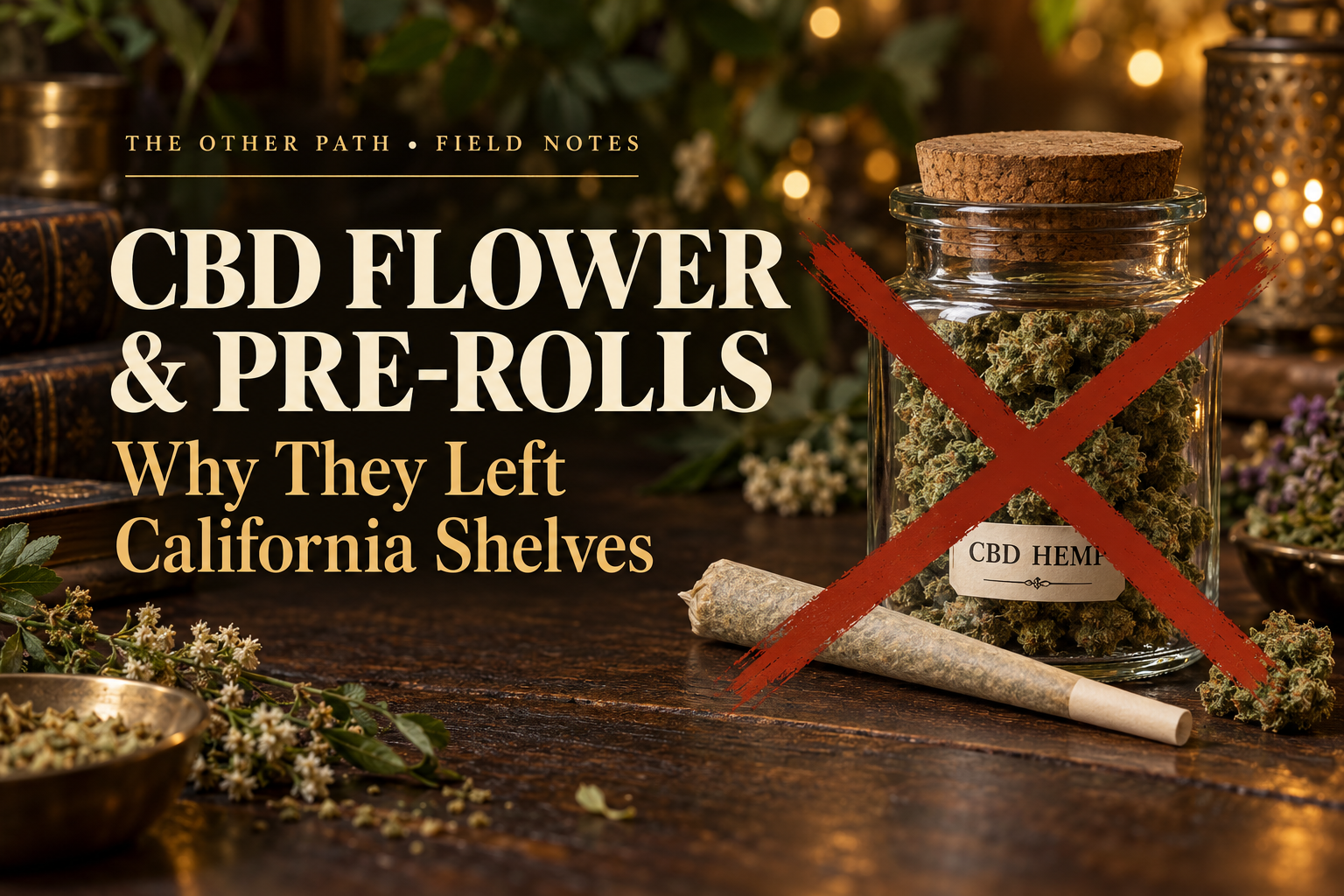
Why even CBD flower and hemp pre-rolls disappeared
People understandably ask why a CBD smokable would be affected if it was not intended to be intoxicating.
California restricts the inhalable hemp category itself. The Department of Cannabis Control lists hemp flower, pre-rolls, vape cartridges, and integrated vaporizers among prohibited hemp products. A CBD label does not create an exception. These restrictions concern hemp products; they should not be described as a ban on every non-hemp herb or every product in a licensed cannabis dispensary. Read the Department of Cannabis Control’s hemp guidance.
That distinction explains why a product could feel familiar, gentle, and very different from recreational THC—and still leave ordinary retail shelves.
Kratom: an enforcement change with immediate local consequences
On November 7, 2025, Los Angeles County Public Health told retailers to stop selling kratom and 7-hydroxymitragynine, commonly called 7-OH, and announced inspections beginning the following week. That made the change visible in neighborhood shops. Read the county’s retailer announcement.
CDPH reiterated its position on January 16, 2026: kratom and 7-OH products sold for consumption are unlawful, and retailers may face enforcement. The state’s retailer letter applies its adulterated-product rules to retail and online sales. This is an important distinction from saying that California passed one new law making every instance of kratom possession a crime. See CDPH’s January notice and its letter to tobacco retailers.
Botanical kratom leaf and concentrated or enhanced 7-OH products are not interchangeable preparations. Nevertheless, the California retail-enforcement notices address both. An explanation that mentions only concentrated 7-OH misses why ordinary kratom products were also removed.
Los Angeles city and county actions are also different. The city’s Council File 25-1357 concerns support for county enforcement efforts; the record shows the item continued in committee on February 6, 2026. That record should not be presented as a newly enacted citywide criminal ordinance. For a Sherman Oaks shopper, the county and state retail-enforcement position is the practical point. View the city record.
What full spectrum, broad spectrum, and isolate mean now
Brands we work with have already reformulated products from full spectrum to broad spectrum. If you have noticed a different description on a familiar bottle, that is part of the industry’s response to the changing rules.
In everyday product language, full spectrum generally describes an extract that retains a range of plant compounds, potentially including THC. Broad spectrum generally describes an extract processed to remove THC while retaining other compounds. Isolate describes a purified individual cannabinoid.
Removing THC helps address one issue, but broad spectrum is not a legal certification. CDPH’s AB 8 guidance says the raw extract used in covered foods, beverages, food additives, and dietary supplements must meet its CBD-or-CBN isolate requirement, with purity greater than 99%, and must not contain THC or synthetic cannabinoids. The guidance treats cosmetics separately and identifies a specific allowance for topically applied cosmetics. A product category, formula, and laboratory report therefore matter more than a spectrum label. Read the category-specific AB 8 FAQ.
For customers, there is no need to become an extraction chemist. Ask what changed, which cannabinoids remain, and whether the current batch report matches the bottle you are buying.
A brief word about the federal “hemp ban”
The phrase describes a narrowing of the federal hemp definition, not a prohibition on every use of the hemp plant. Section 781 of the November 12, 2025 federal law adds exclusions for certain manufactured cannabinoids and finished cannabinoid products exceeding 0.4 milligrams combined per container of total THC, including THCA, and other cannabinoids covered by the law’s THC-like-effects provision. That is a container limit, not a serving limit. Read Public Law 119-37, section 781.
The timing has changed. The original effective date was November 12, 2026. Section 2019 of the September 2, 2026 law delays most of the changes until December 11, 2026, while retaining the original timing for specified exclusions involving cannabinoids the plant cannot naturally produce. This is a partial extension, not a repeal. Read Public Law 119-103, section 2019.
Reformulating away from THC puts a brand in a different position from one selling intoxicating hemp, but it does not automatically settle every requirement. Our approach is to look at the actual formula and documentation rather than treat a frightening headline—or a reassuring label—as the final answer.
What this means when you visit The Other Path
We understand the frustration of losing access to something that was part of your routine. You deserve a clear explanation when a formula changes or a category disappears.
Our focus remains thoughtful botanical education, personal attention, and helping you understand what is in the product in front of you. We can help you compare ingredient lists, understand spectrum terminology, and request current lab results. We cannot promise that every old formula will return or that a product sold elsewhere meets California’s rules.
Before choosing a replacement, bring us three questions:
- What changed in this formula?
- What does the current batch report show?
- What should I discuss with my pharmacist or health professional before using it?
The regulations may change the shelves. They do not change our belief that people should have understandable information and a friendly place to ask questions.
Wander through the Herbarium, request lab results, or contact our Sherman Oaks team.
This article describes selected retail-access changes and official guidance checked on October 31, 2026. It is educational information, not legal or medical advice, and does not certify any particular product’s compliance. Rules, implementation, and enforcement can change; check the linked official sources for updates.